GEO in 2026: How to Get Your Website Cited by ChatGPT, Gemini and Google AI Mode
Generative Engine Optimization (GEO) explained for 2026 — how AI search picks its sources and a practical checklist to get your website cited in ChatGPT, Gemini, Perplexity and Google AI Overviews.
by Pradeep Rajpurohit5 min read
Search changed more in the last two years than in the decade before it. A growing share of people now get their answer straight from an AI — Google’s AI Overviews and AI Mode, ChatGPT search, Gemini, Perplexity or Copilot — and only click through to the few websites the AI cites.
That makes one question very important for any business website in 2026: when an AI answers a question about your industry, is your website one of the sources it quotes?
The practice of earning those citations is called Generative Engine Optimization (GEO). Here is how it works and what you can do about it this week.
What GEO actually is
GEO is not a new trick that replaces SEO. AI answer engines still need to find your page (crawling and indexing), trust it (authority and accuracy) and understand it (clear structure). That is classic SEO.
What GEO adds is a focus on the last mile: making your content easy to extract and quote. An AI is building a short answer from many pages. The pages it picks are the ones that state facts clearly, answer the question directly and look trustworthy.
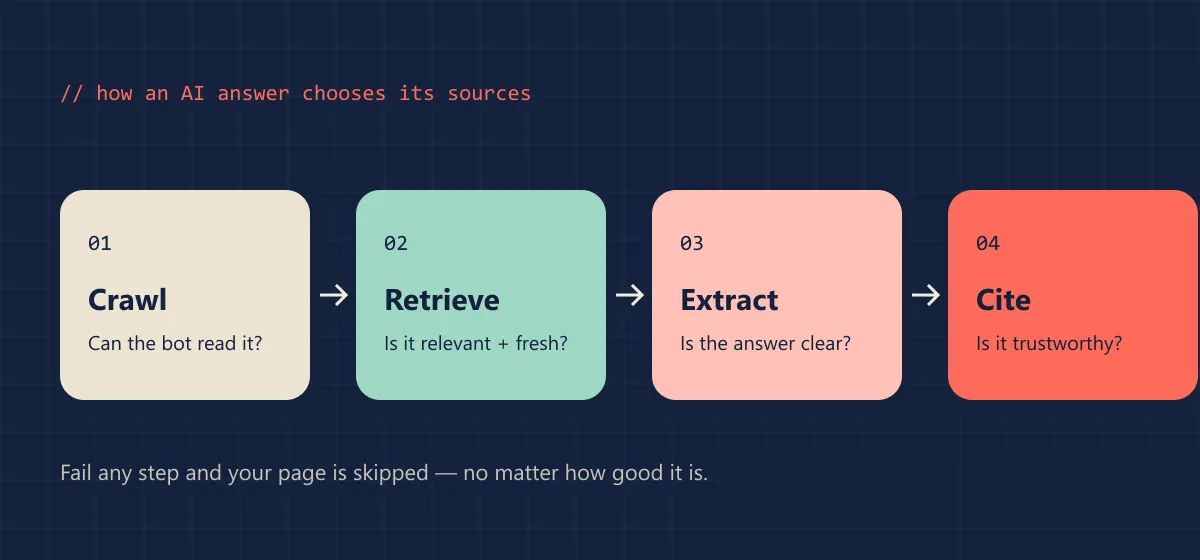
Step 1: Make sure AI crawlers can read your site
You cannot be cited if you cannot be crawled. Check three things:
- robots.txt — make sure you are not accidentally blocking crawlers such as
OAI-SearchBot,PerplexityBotorGooglebot. BlockingGoogle-Extendedstops Gemini training, but it does not remove you from AI Overviews — those use normal Googlebot. - Server-rendered HTML — many AI crawlers do not run JavaScript well. If your content only appears after a heavy React app loads, some bots see an empty page. Static or server-rendered sites (Astro, well-built WordPress, Shopify themes) are safer.
- XML sitemap — keep it up to date with accurate
lastmoddates so fresh content gets picked up quickly.
Step 2: Write answer-first content
AI engines love content that answers the question in the first two sentences of a section, then expands. In practice:
- Use the real question as your heading — “How much does a Shopify store cost?” beats “Pricing considerations”.
- Answer it directly in 40–60 words right below the heading.
- Then add the detail, examples, steps and exceptions.
This is also exactly what earns featured snippets in normal Google results, so you win twice.
Step 3: Be specific and verifiable
Vague content gets ignored. Content with concrete, checkable facts gets quoted. Compare:
- “Our websites load fast.” — nothing to cite.
- “Our last 10 builds scored an average LCP of 1.4 seconds on mobile in field data.” — a fact an AI can repeat.
Add numbers, dates, named tools, prices, step counts and your own results. Original data — a small survey, a case study, a benchmark — is one of the strongest citation magnets there is.
Step 4: Add structured data
Schema markup (JSON-LD) tells machines exactly what a page is about. For most business sites, focus on:
Organization/LocalBusiness— your name, logo, address, contact and social profiles.Article/BlogPosting— author, publish date and updated date.FAQPage— question-and-answer pairs.ProductandReviewfor e-commerce.BreadcrumbListfor site structure.
Structured data does not guarantee a citation, but it removes ambiguity — and AI systems strongly prefer unambiguous sources.
Step 5: Show real expertise (E-E-A-T)
Google’s E-E-A-T guidelines — Experience, Expertise, Authoritativeness, Trust — matter even more when an AI decides who to quote. Make it obvious who wrote the page and why they know the topic:
- A named author with a short bio and a link to an about page.
- First-hand experience: screenshots, client examples, “here’s what happened when we tried this”.
- Clear publish and updated dates — stale content is skipped for anything time-sensitive.
- Contact details, a privacy policy and a real business address.
Step 6: Get mentioned beyond your own website
AI models learn about brands from the whole web, not just your site. Mentions on trusted third-party sites — industry directories, Reddit and Quora discussions, YouTube, LinkedIn articles, podcasts, local news, Google Business Profile reviews — all shape whether an AI recommends you.
A consistent brand name, description and set of services everywhere makes it much easier for an AI to connect the dots.
Step 7: Measure it
GEO is still young, but you can track it:
- In Google Analytics, look at referral traffic from
chatgpt.com,perplexity.ai,gemini.google.comandcopilot.microsoft.com. - In Google Search Console, AI Overview and AI Mode clicks are counted inside your normal Performance report.
- Once a month, ask the AI tools the ten questions your customers ask most and note who gets cited.
What about llms.txt?
llms.txt is a proposed plain-text file that lists your most important pages for language models. It is a community proposal, not an official standard, and Google has said it does not use it. It takes ten minutes to add, so it does not hurt — just do not expect it to do the heavy lifting. Good content, clean HTML and a sitemap matter far more.
The short version
GEO in 2026 comes down to: be crawlable, answer questions directly, be specific, mark up your content, prove your expertise and get mentioned around the web. None of it is a hack. It is simply good SEO, written for a reader that happens to be a machine.
Want to know how AI-ready your website is? Take a look at our SEO service or get in touch and we will review your site. If speed is holding you back too, read our Core Web Vitals guide for 2026.
Frequently asked questions
What is GEO (Generative Engine Optimization)?
GEO is the practice of making your content easy for AI search tools — ChatGPT search, Gemini, Perplexity, Copilot and Google AI Overviews / AI Mode — to find, understand and cite as a source in their generated answers.
Is GEO different from SEO?
GEO is built on top of SEO, not a replacement. AI engines still rely on crawlable pages, search indexes and trust signals. GEO adds a focus on answer-first writing, clear facts, structured data and brand mentions across the web.
Do I need an llms.txt file?
It is optional. llms.txt is a community proposal, not an official standard, and Google has said it does not use it. It costs almost nothing to add, but it will not replace good content, clean HTML and a sitemap.
How do I know if AI tools are citing my website?
Check referral traffic from chatgpt.com, perplexity.ai, gemini.google.com and copilot.microsoft.com in Google Analytics, and regularly ask those tools the questions your customers ask to see which sources they cite.
- #geo
- #ai search
- #ai overviews
- #chatgpt
- #seo 2026